Wednesday, October 18, 2006


The cat had a good time.

Tuesday, October 17, 2006

This weekend's weather was different: Rain. Clouds. Rain with snow. Blue sky with puffy clouds. Rain out of a blue sky. Clouds. More rain with snow. The weather changed on average every half hour. Not wonderful for S who spent the weekend camping in tents, but he only came home tired, cold and muddy, not discouraged or upset.
The weather this week appears to be about the same (maybe 15 degrees warmer) but spread out more. Yesterday was sunny, blue sky with puffy clouds. Today is flat grey light, a sky with no hint of blue, and a drizzly sort of rain that promises to last all day. The camera is not at all happy with the lighting, and even with its flash is giving me dull out of focus pictures.

This blob is Icarus. Moving into the homestretch of the plainish knitting, the rows are getting longer and longer. Only 300 stitches or so, but it's noticeable that I'm only getting a few rows in at a time. I was trying to cheat get a ballpark figure of how many repeats were needed before the border started. I counted repeats in the picture, counted my repeats and had to recount each several times. I finally came to the conclusion that the model was shorted by several repeats from the instructions; each repeat takes 10 stitches, there are apparently only 28 repeats shown on the model and the instructions call for 375 stitches before moving into the border. No big deal except that the finished shawl will be bigger than the model which is a good thing in my opinion. And yes, all of this fussing and calculating did take a good deal longer than just looking up the stitch count in the first place. You be hush.
I'm still making progress on the silk on the wheel, but it looks just like the silk on the wheel from earlier. This is silk/merino (50/50) which my sister gave me for Christmas last year. This is the first bit off the spindle and is going to a. take forever and b. be gorgeous. With shifting into winter mode, the spinning can go a little faster since the silk isn't sticking to my hands with humidity.

Friday, October 13, 2006

Procrastination

This is the rework of the previously mentioned Dale-in-progress. I ripped back to the top of the ribbing, added the row of 3x1 ribbing to encourage the transition to be a little more smooth and then proceeded onwards. I've given no hint of scale, but the ribbing was about 3 inches deep. I had about 2 or 3 more inches of knitting done originally, and as usual, the sight of knitting going in reverse is deeply painful to J. I assured him that I don't think this bit will be done in reverse again.

I am, however, procrastinating on recalculating the raglan seam lines. I realized when I was looking at the schematic that while the overall measurements of this sweater as designed are the same as the sweater I'm supposed to be replacing, the underarm cuts 3 inches higher. Somehow I don't think that this is going to be acceptable. He likes the way the old sweater fits and I am pledged to try to reproduce it. (In new warmer yarn and with a different but equally subdued pattern across the chest, of course. And the addition of a short zipper at the neck, which he thought was a cool idea but not cool enough to go to a drop shoulder model. ) This means I'm going to have to recalculate the raglan seam decreases. Well, maybe not today. After all I don't need those calculations until the acres of stockinette on the body (and the bottom part of the patterned bit on the body) and two sleeves are done. Why I've got loads of time.

And in the meantime, we can admire what's left of the bit of snow that dropped last night. The lone remaining sunflower looks sort of ok from a distance, but it has that fragile ragged look about it that I think means "frost damage". I haven't dared to look at the mums and the zinnias in the front yard since the sun hit them this morning.

Tuesday, October 10, 2006

Opinions wanted...

I started a sweater last year from the Dale Heilo (100% wool) and only got about 5 inches done (ribbing up in the round) before the heat and humidity forced it to be set down. I was not very consistent in my knitting, apparently, and was having gauge worries before I put it down. (6 stitches to the inch gauge for the pattern, and I was getting 5.75 to 6.5, depending on where I measured). Having picked it up again, I'm now getting spot on gauge but the difference in the past two inches vs. the previous 5 was quite evident and annoying.
So, what was I to do? Rip, of course. The yarn I took out from the past two days knitting was not particularly kinked, but the yarn that's been sitting for six months was. I put it in warm water for 10 minutes and then hung it to dry and the kinks are mostly gone.
The question: Should I skein and do the rest of the yarn so it's all been equally rinsed hung and dried?

Sunday, October 08, 2006

The Red Scarf Project is a subject dear to my heart, for no particular reason except that I was a very late bloomer when it came to wanting to leave the nest. Had I been in a position of having no back up, I'm sure I would never have made it. So, with that in mind, my first red scarf: Stats: Cascade 220 (superwash), 6 inches wide, 64 inches long, made up the pattern as I went along with help from BW Treasury 3.

Monday, October 02, 2006

Neighbors and Beginner Triangle

The neighbors are planning their lovely Christmas party again. It was a very nice party with the minor problem of The Gift Exchange. (Just for The Girls. I think I ranted enough about "The Girls" as a title last time.) Everybody has to bring a gift (Under $10) to exchange. They all (The Girls) whined about not being able to actually See the gift before they agreed to take it. All the gifts (mostly) were $30 to $40 which they had thriftily made Under $10 by buying them off the discount and closeout counters. Mostly at Walmart I think. I wasn't enthused.
I'm going to have to consider seriously what to take or if I'm going to bother. I was lucky and wound up with one of the few things I would have given house room to - a "purse" which makes a nice knitting bag. Most of them I would have had to ashcan - heavily scented stuff, guaranteed to give me a headache in 5 minutes or less.

The Triangle is finished

I started with two kinds of top. The multicolored is BFL that someone in the guild dyed. That was one ply, obviously variegated. The other ply was the cherry that I dyed, Rosemary top from the Falklands. The cherry colored solid is the same shade as the darkest red in the BFL.

I started knitting in late July, just before going on vacation. I ripped back quite a bit because I felt I wasn't going to have enough yarn and shortened the whole thing by one set of diamonds down the middle. Done side to side, the center set of diamonds I worked to, and which I removed, represented 3000 stitches. A wise decision, as the bit you see here is all that's left now that I'm done.

The Beginner's Triangle from Gathering of Lace is a very nice shawl, with an easy lace pattern which lends itself to mindless knitting. All but one of the return rows in the pattern are pure garter stitch. The pattern, once established, is easy to see and memorize. All in all, a good beginner pattern.
The only tricky bit was deciding where the middle was and starting my decreases, which were dictated not by the size of the shawl, but by the amount of yarn I had on hand. This is quite large enough. It relaxed quite a bit after washing, giving me another 4 or 5 inches of width and another 2 of depth. This is irrelevant in this shawl, but would be a matter of serious concern in a sweater from a similar yarn. Done vertically as most sweaters are, another 4 or 5 inches of length would be quite noticeable.
I finished the shawl on Saturday, washed and patted into shape to dry, and then wore it on Sunday. Several people at church had seen it in progress and were interested in seeing the final product.

I ran into my neighbor after church. "Why Elizabeth, that's just lovely. You should make another one and put it in the Gift Exchange at the party."

Thursday, September 28, 2006

This skein looks sort of like the skein in the last post, but it's really a new skein. Honest. It's really the second skein of unknown yardage and grist, awaiting measurement and a plan. Sometime. Mostly I was just tired of looking at the stuff and wanted it spun up and into the next phase of waiting for attention.
I was asked recently whether I spun for spinning's sake or whether I spun to have yarn to use and actually used it. The answer sort of is "both". I spin because I like to - it is a different process and product than the rest of my fiber activities. I usually don't start spinning with a project in mind, but often by the time I have the first skein done, a project has come to mind. This project often has to wait for a while because I have other projects in the knitting queue ahead of it. As long as I still look at that yarn and see that project as one I want to do, I keep the yarn, but it's in the knitting queue not the spinning queue now. If I look at the yarn and no longer see that project as one I want to do, there's no longer any point in keeping the yarn. About once I year, I purge the yarn closet. Skeins that are left over from finished projects (I believe I did mention overbuying for projects once or twice before), skeins that were from interesting spinning projects but which didn't result in yarn that elicited a desired knitting project, and skeins such as these from overpurchase of fiber wind up in a box to Manhattan. These particular skeins may very well wind up in hats meant for Dulaan, but if I don't get to them within a year or so, they'll wind up in a box elsewhere. I don't see any point at all in cluttering up my closet and my mind with unplanned for yarn; someone should use it for something useful.

This is a yarn that has no particular project in mind. It's spinning project, meant to stretch in a different direction and has been a great deal of fun. This is a three ply 100% Bombyx silk (Chasing Rainbows). (Obligatory dime picture below.)

This skein is about 380 yards and is approximately 2 ounces of fiber, so should be approximately 3040 ypp. Ok - that's well into the laceweight range. The second skein is in the works.

And then we have "Homespun" (a product name I truly despise), my version of same. Mine is alpaca and leftover silk single. The silk single is from the three-ply above. The alpaca was ripped through as a fat single (one of these fill a bobbin with poorly prepped fiber in 15 minutes or less deals). Plying took another 15 minutes. But! I don't have to look at the single or the fiber anymore, it will make a nice warm thick-thin cap for somebody which I will felt a little bit (I'll do something with it - I wouldn't foist this yarn off on anybody) and it was a nice temporary change from the fiddliness that is silk spinning.


Thursday, September 21, 2006

Finally! I was beginning to think that my schedule and blogger's schedule were never going to coincide. I have pictures! First up is the Brown Sheep Wild Raspberry top that I started spinning up as a laceweight a while back (no fair going back through the blog to figure out how long a while is). When I got many yards of laceweight done, I quit. I have enough for Icarus, that is enough. So... wanting to be done with the rest of it, I spun it up quick and dirty. I now enough an unmeasured number of yards of approximately worsted weight that I will use in an unknown project. Sometime. Maybe. It is a never ending source of amusement and amazement, the difference in hand, drape and look that one can get by varying the style of spinning.
Then we have what I was clearing the decks of Brown Sheep to get to:
Chasing Rainbows silk. I have a number of silks (from various sources)that have been building up in the queue and I'm determined to get them done. This is the first one, popping out of the queue first by virtue of having been started and then left because I started it without finishing the then previous project and then starting another project because the silk was packed in the boxes and the spinning wheel wasn't, and then some other project came along... You get the picture. Three years later, here we are. This is the third bobbin. I'm preserving the color changes in large blocks and the thought is that I'm going to do this as a circular shawl, center out. I think the long repeats will make it reasonable for a lace shawl, since the color changes should not distract from the pattern. I'm dying to figure out how much yardage I have. Even at a 3 ply, this is going to be fairly fine. Just this bit represents 3 hours of spinning for me, and I'll have 8 or 9 hours in a finished bobbin. By contrast the worsted weight in the picture above represents 2 hours of spinning (one for each ply) and less than half an hour of plying, with a bobbin that was physically full each time.

Tuesday, September 19, 2006

It must be some sort of Murphy's corollary - I have time and ideas and am ready to post pictures and babble about them. So, what does the camera say? "Please change batteries". And stubbornly refuses to do anything until I follow directions. Do I have any batteries ready that go in the new camera? Don't be silly.

Tuesday, September 12, 2006

Once upon a time (in California, so it was many years ago) I bought 3 books all at the same time about knitting lace. One was Traditional Knitted Lace Shawls by Martha Waterman, one was The Lacy Knitting of Mary Schiffmann by Nancy Nehring, and one was Shetland Lace by Gladys Amedro. I can tell you this now, but for some years, I couldn't. I didn't remember.
In 2000, we moved from CA to OR. I bought these books about a month before we moved and started knitting one of the shawls. These shawls are not charted, just written out, and Ms Amedro used her own notation so it took learning that notation to get started. You start with the border and knit repeat after repeat until it is long enough. I had 82 of 84 repeats finished. The knitting bag was in the car. The car was broken into the week before we left CA and the bag (including contents) was stolen, apparently to carry along the other stuff taken from the car. I'm sure having a radio stuffed in on top of the knitting did it no good.
I was extremely bummed out losing my knitting with that many repeats done. I was also extremely busy trying to get the house ready to sell and the stuff packed up to move to OR and my children were 7 and 5 at the time, still needing a great deal of attention at this stressful period of time. I did not run right out to replace the book.
I moved to OR, got settled into the new house, got a new job, all that lovely stuff. I started unpacking books. I could only find one of the books (the Waterman). Which book was the book I lost? (And why couldn't I find the other book, or a few other books of a similar nature?) The local store didn't have any of them so that I could look at it. What was the name of it? You have to understand this was a couple of years later and I wasn't concentrating on the problem, just idly wondering.
Then, we moved again, from OR to NY. When unpacking in NY, I suddenly came upon a box that was oddly packed. There were a few things on top, a ton of packing paper, and a set of books on the bottom. My missing knitting books, and oh, yes, it was the Mary Schiffmann book which was the second book, but what was the third one?
Today I stumbled across on a blog entry that mentioned Brora Black out of the Amedro book on Shetland Lace. Bingo! I'm so happy.

Of course, it's out of print and nobody has a copy that I can even get a relative price off of...
Morning sky


Sunday, we went and watched rockets. This is one of J's taking off - a model of a Canadian Arrow. He had fun playing with the new camera, getting the rockets just as they lifted. You can see the flame spurting out of the bottom.

We go down to Geneseo, to the field owned by the 1941 Historic Air Group, who graciously allows the rocket clubs to use their space. This time, HAG was having their fall barbecue/corn roast and people were flying in to get some. There was a constant stream of little planes coming in and going out and each time they went over the field, the rockets had to stop. (reasonably enough). This was complicated this time by the wind - just enough of it that if the planes came from the west, we couldn't hear them coming. We were having to be extra vigilant.
There is a B17 that has apparently taken up residence at the field. It went out once - making a loud coughing noise on take off but apparently not serious enough to make the pilot abort the take off. One engine sounded off tune after that, but it wasn't enough to stop him from buzzing the field and flying circles for a while. It got interesting when we noticed that a Cesna was taking off just as the B17 was setting up for the approach to land. The Cesna apparently didn't see him ? or thought he had more time? We don't have a radio at the rocket site so we don't know what was said, but that Cesna sure took off in a hurry and banked way right just after take off in a way I've not seen done at that airport before. The B17 landed without incident after that. Someone said the airport isn't controlled, so I suppose the pilots have to work it out among themselves.
We also saw a plane with Coast Guard markings take off, among all the rest. It was a two seater biplane I had been admiring on the ground and I was amused to note as the pilot got in the front seat that he definitely stepped on the wing where it said "No Step". I had been wondering just how a person got into the plane with the contortions indicated by the "Step" and "No Step" markings on the side of the plane.
I got some knitting done while I was there (big surprise, eh?). I always get comments on what I'm doing, particularly if I've taken a spindle. I told one fellow I saw no reason not to practice my hobby while watching John practice his. He sighed and said he wished his wife felt the same way.

Saturday, September 09, 2006

Trying again
Shawls: This is the Beginner Triangle Shawl from GOL, done in handspun and the close up picture is much truer to color than the one with the flash. One ply of the yarn is a dark red, the other ply is a variegated red/orange/yellow. The whole is soft and cushy in the hand. I'm not sure if I'm running out of yarn. Theoretically I have enough, but in actuality? Then we have Icarus in progress. Lovely mindless knitting in handspun Brown Sheep top laceweight. I don't care for the 15% mohair content; someday I will remember this before I buy stuff rather than after. It makes the yarn a trifle wirey in the fashion I have spun it, but it does control the ends enough that I don't find it itchy. Everything's a tradeoff donchaknow.
This, on the other hand (while not yet yarn, much less a shawl), I expect to be nothing but softness incarnate. Chasing Rainbows bombyx/merino. It arrived in the box with my shawl returned from Spindlicity - a consolation prize one supposes. I consider myself properly consoled.

Friday, September 08, 2006

Things that make me crabby:
1. Having blog posts vanish into the ether just as I hit "publish".
2. Having people drive along at 2 miles per hour looking for a parking spot they can get their honking big SUV into. (Ok, so I drive a honking big stretch minivan on occasion. I know how to park it without having to test park 3 times before finally pulling into a space and a half in the empty section of the parking lot and then having to spend five minutes backing and filling to make it come out right.)
3. Having the receptionist at the Drs. office tell me someone will call me within 48 hours about a form she was supposed to hand me on the spot, necessitating a return trip and a new parking fee on my part.
4. Having my children pop their heads in every two minutes: Can I have the computer yet?
5. Not knowing whether I have enough yarn to finish a project. I overbuy just to avoid this one.

Due to #1 and #4, I'm crabby in a big way at the moment. I was going to show you reasonably lovely pictures of shawls but it will need to wait. I'm going to go knit faster and see if I can get out of #5 or if I'll need to rip back.

Sunday, August 20, 2006

From the sogginess and heat of the east coast to the sogginess (relative) and coolness of the Oregon coast was a big enough jump; moving from there to the 95 F and 0% humidity of Boise Idaho has been a huge change. Can you say summer time vacation? I brought two shawls with me to work on; one is lace weight and springy, no memory for stitches at all. Once I drop stitches, there's not much help for it but to rip. I dropped a section of 6 stitches last night - can you say Ouch? I couldn't. I just shuddered, trapped the miscreants and put it away. Maybe tomorrow. The other is the Beginner Triangle from GOL - it's on the downhill slide - every row is shorter than the previous and moving along quickly. Someday I'll have pictures. Shawls and scenery. But there's more scenery to get through between now and then - Craters of the Moon, Yellowstone, the Great Salt Lake, Yosemite, San Francisco...

Thank you for all the kind thoughts about Bitsy. 17+ years is a long time. She never was a very snuggly kitty, but she had her moments and we will miss her.

Friday, August 11, 2006


RIP

Bits O'Grey

March 1989 - 11 August 2006

AKA Bitsy, Bits, B-Cat and The Squeaker.

Thursday, August 10, 2006

More summer reading

Checking out the library's "new" shelf, I happened upon and a Bottle of Rum: History of the New World in 10 Cocktails, which I had been intending to read, and The Girls Who Went Away, which I had never heard of before. Both extremely readable and quite interesting.

and a Bottle of Rum is a history of rum (no duh) which involves the history of the islands where it originated and the history of the US as it involves rum. My interest in history of England or the US ended, when I was in school, about 1600. Anything after that was too new to interest me. Consequently, as a an adult, I am constantly surprised and intrigued with those books that attract my attention which introduce me to the history of the US after 1600. This is one of those books. My knowledge of the beginnings of the American Revolution has been limited to what 11th grade American History managed to get into my head, i.e. the British imposed the Stamp Act and a tax on tea, out of the spitefulness of their hearts and we obviously stood up for ourselves and said we objected. Right. Who knew there was a Sugar Act before that, and even before that the Molasses Act, both of which had to do with other British colonies protecting their turf? Well obviously, plenty of people must have known this and obviously I didn't. (Well, I've already confessed my complete ignorance on the subject.) It also explains in later chapters a great deal more that fits in with what I learned about Susan B. Anthony when I was reading up on her a year or so ago, and why we had the Great Experiment. Very interesting reading.

I suppose I could do some serious reading on American History and quit treating the subject like a huge jigsaw puzzle, but there is a certain pleasure to be found in stumbling across new pieces.

The Girls Who Went Away discusses a much more recent portion of US history - the girls of the 40s and 50s who became pregnant, usually out of wedlock, and who gave up their children for adoption. The author has done an oral history study, talking with women who are willing, and sometimes eager, to talk about their experiences in being birth mothers. I found this a very difficult book to read, not because it was badly written (it isn't), but because it was very emotional. The people being quoted were emotional, and I became so in reading their stories. The historical and social environment that lead up to so many (comparatively speaking) young women surrendering their children for adoption is something I had never really studied before, and yet so much of it resonated with my girlhood (growing up in the 60s and early 70s) and resonates today with the conservative element trying to push us back to the 50s. I have read of the difficulties that adoptees had in dealing with their adoption, and obviously there has been a big push to open records so that they may learn their genetic and cultural heritage. This is the story of the other side of the coin - women who were forced by circumstances, their families, their position in their society, into giving up their children when what they wanted was simply support in keeping their children. Obviously just part of the story - many of the women wanted to talk because the events they went through caused them such pain, but still a valid portion of the history of those times.

Saturday, August 05, 2006

Someone passed this along. It's called The Size of the World, but I like Perspective better.

Thursday, August 03, 2006

Katy Shawl Questions and Variations

Katy 1 was done in handspun. Looking at it closely again, I think I goofed when I said 1 ply corriedale - I think it actually was 2 ply and 1 ply silk. It is approximately fingering/sport weight yarn, I used a #4 US needle, and the whole shawl weighs approximately 185 grams. Using a very conservative number on generic fingering length, that should be approximately 1000 yds, but was probably less than that, more like 7 or 800. ( Calculation is necessary because a. I didn't keep the leftover yarn or if I did I can't find it, b. This was a seat of the pants creation to start with, and I didn't even do the minimal record keeping I now do.) If I were to do this again, I'd probably allow myself 1000 yds just because I'm conservative like that.

Katy 2 was done in Jaeger Trinity(using #7 US needles), which comes in 50 gram balls, 218 yards each. (see above lack of records) Weighing the thing now, it's 196 grams. Logic would say, I used 4 balls completely. I bought 6 or 7 to start with to make sure I had enough and had a bunch left over. If I were doing it again now I'd start with 5 balls (or maybe six because I like to overbuy and hate worrying about running out. Consult your panic level on the subject of running out. Believe me, you don't want to get down to the end of this border and decide you have to rip it out and make the thing shorter.)

Katy 1 variation: Let line 6 read: k3, k2, (yo,k2tog,k3) 5 times, yo,k2tog, k1, k3. ( 36). This does not make allowances in the full pi stitch count for the border stitches and consequently (since these stitches are not doubled at the increase rows) the total stitch count at the end is much less, leaving you with a half pi. This will require adjustments in the number of repeats on pattern rows, and may affect how many stitches are odd at the ends of such rows. It will also affect the number of repeats of the border pattern.
Also, I didn't think the shawl was long enough and didn't want to double the stitches again, so I did an extra set of pattern (repeat rows 34-41) at row 58 before going on into the repeat called for at row 58 as listed.

Katy 2 variation: I find that with a worsted cotton yarn, the fabric of this pattern looks better if the motifs are slightly farther apart. I'll post about that in another entry.

Tuesday, August 01, 2006

Katy Shawl
1. Cast on 9 stitches.
2. Knit in front and back of all stitches (18).
3. Knit across.
4. Knit in front and back of all stitches (36).
5. K3, P30, k3. (establish 3 stitch garter stitch border)
6. K3, k2, (yo, k5) 5 times, yo, k3, k3. (42) (increase stitches so that 6 border stitches are removed from count of stitches to be increased later).
7. K3, p36, k3.
8. K3, knit in front and back of next 36 stitches, k3. (78)
9. K3, P72, k3.
10. K3, k3, (yo, ssk, k4) 11 times, yo, k2tog, k1, k3.
11. K3, p72, k3.
12. K3, (k1, k2tog, yo, k1, yo, ssk) 12 times, k3.
13. K3, p72, k3.
14. Knit across.
15. K3, p72, k3.
16. K3, knit in front and back of next 72 stitches, k3. (150)
17. K3, p144, k3.
18. K3, k3, (yo, ssk, k4) 23 times, yo, ssk, k1, k3.
19. K3, p144, k3.
20. K3, (k1, k2tog, yo, k1, yo, ssk) 24 times, k3.
21. K3, p144, k3.
22. K3, k6, (yo, ssk, k4) 23 times, k3.
23. K3, p144, k3.
24. K3, k4, (k2tog, yo, k1, yo, ssk, k1) 23 times, k2, k3.
25. K3, p144, k3.
26. – 29. Repeat rows 18 – 21
30. K3, k2tog (yo, k3, yo, sl1-k2tog-psso) 23 times, yo k3 yo k1 k3
31. K3 p145 k3
32. K4, knit front and back next 143, k4
33. K3, p288, k3
34. K3, k3 (yo, ssk, k4) 47 times, yo, ssk, k1, k3
35. K3, p288, k3
36. K3, k1, (k2tog, yo k1, yo, skk) 48 times, k3
37. K3, p288, k3
38. K3, k6 (yo, ssk, k4) 47 times, k3
39. K3, p288, k3
40. K3, k4 (k2tog, yo, k1, yo, ssk, k1) 47 times, k2, k3
41. K3, p288, k3
42. – 49 Repeat rows 34 – 41
50. – 57 Repeat rows 34-41
58. – 61 Repeat rows 34 – 37
62. K3, k2tog (yo, k3, yo, sl1-k2tog-psso) 47 times, yo k3 yo k1 k3
63. K3, p289, k3 Note: You may stop here and add edging, OR continue in pattern until shawl is as long as desired.
64. k4, knit front and back of next 287, k4 (582 stitches)
65. Repeat in pattern.
The depth of the edging will be approximately half the depth of the section between rows 32 and 64.
When you have the depth of shawl that you want:
1. K3,yo (k2tog, yo) across, k3
2. K3, p across, k3
Repeat rows 1 and 2 two more times, then knit across.

You will now begin border. Keep stitches on circular needle. Using the yarn attached to the body of the work, cast on 19 stitches. Using a single straight needle or dpn of the same diameter of the circular needle, knit those 19 stitches. Knit those 19 stitches again. You are now ready to start edging pattern. On each ODD row, you will knit 2 together using the last stitch of edging and the next stitch of the shawl edge, thereby using one stitch of shawl edge for each 2 rows of edging pattern.
Note: If you start edging after row 63, you will have 42 repeats of the edging; if after row 64, you will have 82 repeats of edging..
Edging pattern: (Snail Shell Edging)
1. K5, p1, yo, p2tog, k8, yo, k2tog, k2tog (19 stitches)
2. K3, yo, k2tog, k5, k2tog, yo k1, yo, ssk, k2, (yo) 2 times, k2 (21 stitches)
3. K3, p1, k1, p2tog-b, yo, p3, yo, p2tog, k6, yo, k2tog, k2tog (21 stitches)
4. K3, yo, k2tog, k3, k2tog, yo, k2, k2tog, yo, k1, yo, ssk, k2, (yo) 2 times, k2. (23 stitches)
5. K3, p1, k1, p2tog-b, yo, p3, yo, p2tog, p2, yo, p2tog, k4, yo, k2tog, k2tog (23 stitches)
6. K3, yo, k2tog, k1, (k2tog, yo, k2) two times, yo, ssk, k1, yo, ssk, k2, (yo) two times, k2 (25 stitches)
7. K3, p1, k1, (p2tog-b, yo, p1) two times, yo, p2tog, p1, yo, p2tog, p2, yo, p2tog, k2, yo k2tog, k2tog (25 stitches)
8. K3, yo, k3tog, yo, k2, k2tog, yo, k1, k2tog, yo, k3, yo, ssk, k1, yo, ssk, k2tog, (yo) 2 times, k2tog (25 stitches)
9. K2, p1, k1, p2, yo, p2tog, p1, yo, p3tog, yo, p1, p2tog-b, yo, p2, p2tog-b, yo, k3, yo, k2tog, k2tog (25 stitches)
10. K3, yo, k2tog (k2, yo, ssk) 2 times, k3, k2tog, yo, k2, sl1-k2tog-psso, (yo) 2 times, k2tog (24 stitches)
11. K2, p5, yo, p2tog, p1, p2tog-b, yo, p2, p2tog-b, yo, k5, yo, k2tog,k2tog (24 stitches)
12. K3, yo, k2tog, k4, yo, ssk, k2, yo, k3tog, yo, k2, k3tog, yo, k2tog,k1 (22 stitches)
13. K3, p1, k3, yo, p2tog, p1, p2tog-b, yo, k7, yo, k2tog, k2tog (22 stitches)
14. K3, yo, k2tog, k6, yo, k3tog, yo, k2, k3tog, yo, k3tog (19 stitches)

When you have one stitch of shawl left, use last stitch in knitting 2 rows plain and bind off.
Crochet a row of single crochet along the first 9 stitches to give some firmness to this area and blend into the border. (These 9 stitches can also be folded together and sewn if your yarn thickness does not make this undesirable). Weave in ends.
Katy Shawl John & Elizabeth Osborn
© 8/1/2006aeosborn@earthlink.netCopyright 23 April 2005
Please do not distribute with permission, or without this copyright notice.
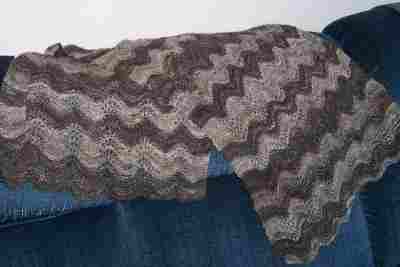
These aren't new creations, but I'm trying to gather up my pictures into a single file folder and thought you might like to see them again. The grey is Beastly Waves. Two different bumps of Beast had very different colors in them, which worked nicely in feather and fan.


This was the first version of the Katy Shawl. One ply brown Corriedale, one ply blue/purple/green silk. The camera picks up the silk more than is really visible in person - the effect is more subtle. It's a half-pi shawl with snail shell edging. Someday I'll finish oroofing the pattern and post it, unless someone wants to proof it for me.
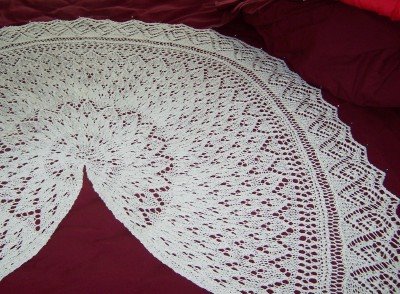
This is the Katy Shawl Mark 2, done in a commercial cotton/silk/polyamide, somewhat bulkier than the original, with slight modifications, like not forgetting to adjust for taking the border stitches out of the body stitch count, which was something I intended to do it in the first version but didn't. It didn't bother me because the first version was a mindless knitting project for meetings, done in a well-what-would-look-good-next sort of fashion.

Stripes was done in spindle spun BFL, dyed by one of the members of the local guild. The pattern was a variation of the Rebozo from Folk Shawls.