From the sogginess and heat of the east coast to the sogginess (relative) and coolness of the Oregon coast was a big enough jump; moving from there to the 95 F and 0% humidity of Boise Idaho has been a huge change. Can you say summer time vacation? I brought two shawls with me to work on; one is lace weight and springy, no memory for stitches at all. Once I drop stitches, there's not much help for it but to rip. I dropped a section of 6 stitches last night - can you say Ouch? I couldn't. I just shuddered, trapped the miscreants and put it away. Maybe tomorrow. The other is the Beginner Triangle from GOL - it's on the downhill slide - every row is shorter than the previous and moving along quickly. Someday I'll have pictures. Shawls and scenery. But there's more scenery to get through between now and then - Craters of the Moon, Yellowstone, the Great Salt Lake, Yosemite, San Francisco...
Thank you for all the kind thoughts about Bitsy. 17+ years is a long time. She never was a very snuggly kitty, but she had her moments and we will miss her.
Sunday, August 20, 2006


Friday, August 11, 2006

Thursday, August 10, 2006
More summer reading
Checking out the library's "new" shelf, I happened upon and a Bottle of Rum: History of the New World in 10 Cocktails, which I had been intending to read, and The Girls Who Went Away, which I had never heard of before. Both extremely readable and quite interesting.
and a Bottle of Rum is a history of rum (no duh) which involves the history of the islands where it originated and the history of the US as it involves rum. My interest in history of England or the US ended, when I was in school, about 1600. Anything after that was too new to interest me. Consequently, as a an adult, I am constantly surprised and intrigued with those books that attract my attention which introduce me to the history of the US after 1600. This is one of those books. My knowledge of the beginnings of the American Revolution has been limited to what 11th grade American History managed to get into my head, i.e. the British imposed the Stamp Act and a tax on tea, out of the spitefulness of their hearts and we obviously stood up for ourselves and said we objected. Right. Who knew there was a Sugar Act before that, and even before that the Molasses Act, both of which had to do with other British colonies protecting their turf? Well obviously, plenty of people must have known this and obviously I didn't. (Well, I've already confessed my complete ignorance on the subject.) It also explains in later chapters a great deal more that fits in with what I learned about Susan B. Anthony when I was reading up on her a year or so ago, and why we had the Great Experiment. Very interesting reading.
I suppose I could do some serious reading on American History and quit treating the subject like a huge jigsaw puzzle, but there is a certain pleasure to be found in stumbling across new pieces.
The Girls Who Went Away discusses a much more recent portion of US history - the girls of the 40s and 50s who became pregnant, usually out of wedlock, and who gave up their children for adoption. The author has done an oral history study, talking with women who are willing, and sometimes eager, to talk about their experiences in being birth mothers. I found this a very difficult book to read, not because it was badly written (it isn't), but because it was very emotional. The people being quoted were emotional, and I became so in reading their stories. The historical and social environment that lead up to so many (comparatively speaking) young women surrendering their children for adoption is something I had never really studied before, and yet so much of it resonated with my girlhood (growing up in the 60s and early 70s) and resonates today with the conservative element trying to push us back to the 50s. I have read of the difficulties that adoptees had in dealing with their adoption, and obviously there has been a big push to open records so that they may learn their genetic and cultural heritage. This is the story of the other side of the coin - women who were forced by circumstances, their families, their position in their society, into giving up their children when what they wanted was simply support in keeping their children. Obviously just part of the story - many of the women wanted to talk because the events they went through caused them such pain, but still a valid portion of the history of those times.
Checking out the library's "new" shelf, I happened upon and a Bottle of Rum: History of the New World in 10 Cocktails, which I had been intending to read, and The Girls Who Went Away, which I had never heard of before. Both extremely readable and quite interesting.
and a Bottle of Rum is a history of rum (no duh) which involves the history of the islands where it originated and the history of the US as it involves rum. My interest in history of England or the US ended, when I was in school, about 1600. Anything after that was too new to interest me. Consequently, as a an adult, I am constantly surprised and intrigued with those books that attract my attention which introduce me to the history of the US after 1600. This is one of those books. My knowledge of the beginnings of the American Revolution has been limited to what 11th grade American History managed to get into my head, i.e. the British imposed the Stamp Act and a tax on tea, out of the spitefulness of their hearts and we obviously stood up for ourselves and said we objected. Right. Who knew there was a Sugar Act before that, and even before that the Molasses Act, both of which had to do with other British colonies protecting their turf? Well obviously, plenty of people must have known this and obviously I didn't. (Well, I've already confessed my complete ignorance on the subject.) It also explains in later chapters a great deal more that fits in with what I learned about Susan B. Anthony when I was reading up on her a year or so ago, and why we had the Great Experiment. Very interesting reading.
I suppose I could do some serious reading on American History and quit treating the subject like a huge jigsaw puzzle, but there is a certain pleasure to be found in stumbling across new pieces.
The Girls Who Went Away discusses a much more recent portion of US history - the girls of the 40s and 50s who became pregnant, usually out of wedlock, and who gave up their children for adoption. The author has done an oral history study, talking with women who are willing, and sometimes eager, to talk about their experiences in being birth mothers. I found this a very difficult book to read, not because it was badly written (it isn't), but because it was very emotional. The people being quoted were emotional, and I became so in reading their stories. The historical and social environment that lead up to so many (comparatively speaking) young women surrendering their children for adoption is something I had never really studied before, and yet so much of it resonated with my girlhood (growing up in the 60s and early 70s) and resonates today with the conservative element trying to push us back to the 50s. I have read of the difficulties that adoptees had in dealing with their adoption, and obviously there has been a big push to open records so that they may learn their genetic and cultural heritage. This is the story of the other side of the coin - women who were forced by circumstances, their families, their position in their society, into giving up their children when what they wanted was simply support in keeping their children. Obviously just part of the story - many of the women wanted to talk because the events they went through caused them such pain, but still a valid portion of the history of those times.
Saturday, August 05, 2006
Thursday, August 03, 2006
Katy Shawl Questions and Variations
Katy 1 was done in handspun. Looking at it closely again, I think I goofed when I said 1 ply corriedale - I think it actually was 2 ply and 1 ply silk. It is approximately fingering/sport weight yarn, I used a #4 US needle, and the whole shawl weighs approximately 185 grams. Using a very conservative number on generic fingering length, that should be approximately 1000 yds, but was probably less than that, more like 7 or 800. ( Calculation is necessary because a. I didn't keep the leftover yarn or if I did I can't find it, b. This was a seat of the pants creation to start with, and I didn't even do the minimal record keeping I now do.) If I were to do this again, I'd probably allow myself 1000 yds just because I'm conservative like that.
Katy 2 was done in Jaeger Trinity(using #7 US needles), which comes in 50 gram balls, 218 yards each. (see above lack of records) Weighing the thing now, it's 196 grams. Logic would say, I used 4 balls completely. I bought 6 or 7 to start with to make sure I had enough and had a bunch left over. If I were doing it again now I'd start with 5 balls (or maybe six because I like to overbuy and hate worrying about running out. Consult your panic level on the subject of running out. Believe me, you don't want to get down to the end of this border and decide you have to rip it out and make the thing shorter.)
Katy 1 variation: Let line 6 read: k3, k2, (yo,k2tog,k3) 5 times, yo,k2tog, k1, k3. ( 36). This does not make allowances in the full pi stitch count for the border stitches and consequently (since these stitches are not doubled at the increase rows) the total stitch count at the end is much less, leaving you with a half pi. This will require adjustments in the number of repeats on pattern rows, and may affect how many stitches are odd at the ends of such rows. It will also affect the number of repeats of the border pattern.
Also, I didn't think the shawl was long enough and didn't want to double the stitches again, so I did an extra set of pattern (repeat rows 34-41) at row 58 before going on into the repeat called for at row 58 as listed.
Katy 2 variation: I find that with a worsted cotton yarn, the fabric of this pattern looks better if the motifs are slightly farther apart. I'll post about that in another entry.
Katy 1 was done in handspun. Looking at it closely again, I think I goofed when I said 1 ply corriedale - I think it actually was 2 ply and 1 ply silk. It is approximately fingering/sport weight yarn, I used a #4 US needle, and the whole shawl weighs approximately 185 grams. Using a very conservative number on generic fingering length, that should be approximately 1000 yds, but was probably less than that, more like 7 or 800. ( Calculation is necessary because a. I didn't keep the leftover yarn or if I did I can't find it, b. This was a seat of the pants creation to start with, and I didn't even do the minimal record keeping I now do.) If I were to do this again, I'd probably allow myself 1000 yds just because I'm conservative like that.
Katy 2 was done in Jaeger Trinity(using #7 US needles), which comes in 50 gram balls, 218 yards each. (see above lack of records) Weighing the thing now, it's 196 grams. Logic would say, I used 4 balls completely. I bought 6 or 7 to start with to make sure I had enough and had a bunch left over. If I were doing it again now I'd start with 5 balls (or maybe six because I like to overbuy and hate worrying about running out. Consult your panic level on the subject of running out. Believe me, you don't want to get down to the end of this border and decide you have to rip it out and make the thing shorter.)
Katy 1 variation: Let line 6 read: k3, k2, (yo,k2tog,k3) 5 times, yo,k2tog, k1, k3. ( 36). This does not make allowances in the full pi stitch count for the border stitches and consequently (since these stitches are not doubled at the increase rows) the total stitch count at the end is much less, leaving you with a half pi. This will require adjustments in the number of repeats on pattern rows, and may affect how many stitches are odd at the ends of such rows. It will also affect the number of repeats of the border pattern.
Also, I didn't think the shawl was long enough and didn't want to double the stitches again, so I did an extra set of pattern (repeat rows 34-41) at row 58 before going on into the repeat called for at row 58 as listed.
Katy 2 variation: I find that with a worsted cotton yarn, the fabric of this pattern looks better if the motifs are slightly farther apart. I'll post about that in another entry.
Tuesday, August 01, 2006
Katy Shawl
1. Cast on 9 stitches.
2. Knit in front and back of all stitches (18).
3. Knit across.
4. Knit in front and back of all stitches (36).
5. K3, P30, k3. (establish 3 stitch garter stitch border)
6. K3, k2, (yo, k5) 5 times, yo, k3, k3. (42) (increase stitches so that 6 border stitches are removed from count of stitches to be increased later).
7. K3, p36, k3.
8. K3, knit in front and back of next 36 stitches, k3. (78)
9. K3, P72, k3.
10. K3, k3, (yo, ssk, k4) 11 times, yo, k2tog, k1, k3.
11. K3, p72, k3.
12. K3, (k1, k2tog, yo, k1, yo, ssk) 12 times, k3.
13. K3, p72, k3.
14. Knit across.
15. K3, p72, k3.
16. K3, knit in front and back of next 72 stitches, k3. (150)
17. K3, p144, k3.
18. K3, k3, (yo, ssk, k4) 23 times, yo, ssk, k1, k3.
19. K3, p144, k3.
20. K3, (k1, k2tog, yo, k1, yo, ssk) 24 times, k3.
21. K3, p144, k3.
22. K3, k6, (yo, ssk, k4) 23 times, k3.
23. K3, p144, k3.
24. K3, k4, (k2tog, yo, k1, yo, ssk, k1) 23 times, k2, k3.
25. K3, p144, k3.
26. – 29. Repeat rows 18 – 21
30. K3, k2tog (yo, k3, yo, sl1-k2tog-psso) 23 times, yo k3 yo k1 k3
31. K3 p145 k3
32. K4, knit front and back next 143, k4
33. K3, p288, k3
34. K3, k3 (yo, ssk, k4) 47 times, yo, ssk, k1, k3
35. K3, p288, k3
36. K3, k1, (k2tog, yo k1, yo, skk) 48 times, k3
37. K3, p288, k3
38. K3, k6 (yo, ssk, k4) 47 times, k3
39. K3, p288, k3
40. K3, k4 (k2tog, yo, k1, yo, ssk, k1) 47 times, k2, k3
41. K3, p288, k3
42. – 49 Repeat rows 34 – 41
50. – 57 Repeat rows 34-41
58. – 61 Repeat rows 34 – 37
62. K3, k2tog (yo, k3, yo, sl1-k2tog-psso) 47 times, yo k3 yo k1 k3
63. K3, p289, k3 Note: You may stop here and add edging, OR continue in pattern until shawl is as long as desired.
64. k4, knit front and back of next 287, k4 (582 stitches)
65. Repeat in pattern.
The depth of the edging will be approximately half the depth of the section between rows 32 and 64.
When you have the depth of shawl that you want:
1. K3,yo (k2tog, yo) across, k3
2. K3, p across, k3
Repeat rows 1 and 2 two more times, then knit across.
You will now begin border. Keep stitches on circular needle. Using the yarn attached to the body of the work, cast on 19 stitches. Using a single straight needle or dpn of the same diameter of the circular needle, knit those 19 stitches. Knit those 19 stitches again. You are now ready to start edging pattern. On each ODD row, you will knit 2 together using the last stitch of edging and the next stitch of the shawl edge, thereby using one stitch of shawl edge for each 2 rows of edging pattern.
Note: If you start edging after row 63, you will have 42 repeats of the edging; if after row 64, you will have 82 repeats of edging..
Edging pattern: (Snail Shell Edging)
1. K5, p1, yo, p2tog, k8, yo, k2tog, k2tog (19 stitches)
2. K3, yo, k2tog, k5, k2tog, yo k1, yo, ssk, k2, (yo) 2 times, k2 (21 stitches)
3. K3, p1, k1, p2tog-b, yo, p3, yo, p2tog, k6, yo, k2tog, k2tog (21 stitches)
4. K3, yo, k2tog, k3, k2tog, yo, k2, k2tog, yo, k1, yo, ssk, k2, (yo) 2 times, k2. (23 stitches)
5. K3, p1, k1, p2tog-b, yo, p3, yo, p2tog, p2, yo, p2tog, k4, yo, k2tog, k2tog (23 stitches)
6. K3, yo, k2tog, k1, (k2tog, yo, k2) two times, yo, ssk, k1, yo, ssk, k2, (yo) two times, k2 (25 stitches)
7. K3, p1, k1, (p2tog-b, yo, p1) two times, yo, p2tog, p1, yo, p2tog, p2, yo, p2tog, k2, yo k2tog, k2tog (25 stitches)
8. K3, yo, k3tog, yo, k2, k2tog, yo, k1, k2tog, yo, k3, yo, ssk, k1, yo, ssk, k2tog, (yo) 2 times, k2tog (25 stitches)
9. K2, p1, k1, p2, yo, p2tog, p1, yo, p3tog, yo, p1, p2tog-b, yo, p2, p2tog-b, yo, k3, yo, k2tog, k2tog (25 stitches)
10. K3, yo, k2tog (k2, yo, ssk) 2 times, k3, k2tog, yo, k2, sl1-k2tog-psso, (yo) 2 times, k2tog (24 stitches)
11. K2, p5, yo, p2tog, p1, p2tog-b, yo, p2, p2tog-b, yo, k5, yo, k2tog,k2tog (24 stitches)
12. K3, yo, k2tog, k4, yo, ssk, k2, yo, k3tog, yo, k2, k3tog, yo, k2tog,k1 (22 stitches)
13. K3, p1, k3, yo, p2tog, p1, p2tog-b, yo, k7, yo, k2tog, k2tog (22 stitches)
14. K3, yo, k2tog, k6, yo, k3tog, yo, k2, k3tog, yo, k3tog (19 stitches)
When you have one stitch of shawl left, use last stitch in knitting 2 rows plain and bind off.
Crochet a row of single crochet along the first 9 stitches to give some firmness to this area and blend into the border. (These 9 stitches can also be folded together and sewn if your yarn thickness does not make this undesirable). Weave in ends.
Katy Shawl John & Elizabeth Osborn
© 8/1/2006aeosborn@earthlink.netCopyright 23 April 2005
Please do not distribute with permission, or without this copyright notice.
1. Cast on 9 stitches.
2. Knit in front and back of all stitches (18).
3. Knit across.
4. Knit in front and back of all stitches (36).
5. K3, P30, k3. (establish 3 stitch garter stitch border)
6. K3, k2, (yo, k5) 5 times, yo, k3, k3. (42) (increase stitches so that 6 border stitches are removed from count of stitches to be increased later).
7. K3, p36, k3.
8. K3, knit in front and back of next 36 stitches, k3. (78)
9. K3, P72, k3.
10. K3, k3, (yo, ssk, k4) 11 times, yo, k2tog, k1, k3.
11. K3, p72, k3.
12. K3, (k1, k2tog, yo, k1, yo, ssk) 12 times, k3.
13. K3, p72, k3.
14. Knit across.
15. K3, p72, k3.
16. K3, knit in front and back of next 72 stitches, k3. (150)
17. K3, p144, k3.
18. K3, k3, (yo, ssk, k4) 23 times, yo, ssk, k1, k3.
19. K3, p144, k3.
20. K3, (k1, k2tog, yo, k1, yo, ssk) 24 times, k3.
21. K3, p144, k3.
22. K3, k6, (yo, ssk, k4) 23 times, k3.
23. K3, p144, k3.
24. K3, k4, (k2tog, yo, k1, yo, ssk, k1) 23 times, k2, k3.
25. K3, p144, k3.
26. – 29. Repeat rows 18 – 21
30. K3, k2tog (yo, k3, yo, sl1-k2tog-psso) 23 times, yo k3 yo k1 k3
31. K3 p145 k3
32. K4, knit front and back next 143, k4
33. K3, p288, k3
34. K3, k3 (yo, ssk, k4) 47 times, yo, ssk, k1, k3
35. K3, p288, k3
36. K3, k1, (k2tog, yo k1, yo, skk) 48 times, k3
37. K3, p288, k3
38. K3, k6 (yo, ssk, k4) 47 times, k3
39. K3, p288, k3
40. K3, k4 (k2tog, yo, k1, yo, ssk, k1) 47 times, k2, k3
41. K3, p288, k3
42. – 49 Repeat rows 34 – 41
50. – 57 Repeat rows 34-41
58. – 61 Repeat rows 34 – 37
62. K3, k2tog (yo, k3, yo, sl1-k2tog-psso) 47 times, yo k3 yo k1 k3
63. K3, p289, k3 Note: You may stop here and add edging, OR continue in pattern until shawl is as long as desired.
64. k4, knit front and back of next 287, k4 (582 stitches)
65. Repeat in pattern.
The depth of the edging will be approximately half the depth of the section between rows 32 and 64.
When you have the depth of shawl that you want:
1. K3,yo (k2tog, yo) across, k3
2. K3, p across, k3
Repeat rows 1 and 2 two more times, then knit across.
You will now begin border. Keep stitches on circular needle. Using the yarn attached to the body of the work, cast on 19 stitches. Using a single straight needle or dpn of the same diameter of the circular needle, knit those 19 stitches. Knit those 19 stitches again. You are now ready to start edging pattern. On each ODD row, you will knit 2 together using the last stitch of edging and the next stitch of the shawl edge, thereby using one stitch of shawl edge for each 2 rows of edging pattern.
Note: If you start edging after row 63, you will have 42 repeats of the edging; if after row 64, you will have 82 repeats of edging..
Edging pattern: (Snail Shell Edging)
1. K5, p1, yo, p2tog, k8, yo, k2tog, k2tog (19 stitches)
2. K3, yo, k2tog, k5, k2tog, yo k1, yo, ssk, k2, (yo) 2 times, k2 (21 stitches)
3. K3, p1, k1, p2tog-b, yo, p3, yo, p2tog, k6, yo, k2tog, k2tog (21 stitches)
4. K3, yo, k2tog, k3, k2tog, yo, k2, k2tog, yo, k1, yo, ssk, k2, (yo) 2 times, k2. (23 stitches)
5. K3, p1, k1, p2tog-b, yo, p3, yo, p2tog, p2, yo, p2tog, k4, yo, k2tog, k2tog (23 stitches)
6. K3, yo, k2tog, k1, (k2tog, yo, k2) two times, yo, ssk, k1, yo, ssk, k2, (yo) two times, k2 (25 stitches)
7. K3, p1, k1, (p2tog-b, yo, p1) two times, yo, p2tog, p1, yo, p2tog, p2, yo, p2tog, k2, yo k2tog, k2tog (25 stitches)
8. K3, yo, k3tog, yo, k2, k2tog, yo, k1, k2tog, yo, k3, yo, ssk, k1, yo, ssk, k2tog, (yo) 2 times, k2tog (25 stitches)
9. K2, p1, k1, p2, yo, p2tog, p1, yo, p3tog, yo, p1, p2tog-b, yo, p2, p2tog-b, yo, k3, yo, k2tog, k2tog (25 stitches)
10. K3, yo, k2tog (k2, yo, ssk) 2 times, k3, k2tog, yo, k2, sl1-k2tog-psso, (yo) 2 times, k2tog (24 stitches)
11. K2, p5, yo, p2tog, p1, p2tog-b, yo, p2, p2tog-b, yo, k5, yo, k2tog,k2tog (24 stitches)
12. K3, yo, k2tog, k4, yo, ssk, k2, yo, k3tog, yo, k2, k3tog, yo, k2tog,k1 (22 stitches)
13. K3, p1, k3, yo, p2tog, p1, p2tog-b, yo, k7, yo, k2tog, k2tog (22 stitches)
14. K3, yo, k2tog, k6, yo, k3tog, yo, k2, k3tog, yo, k3tog (19 stitches)
When you have one stitch of shawl left, use last stitch in knitting 2 rows plain and bind off.
Crochet a row of single crochet along the first 9 stitches to give some firmness to this area and blend into the border. (These 9 stitches can also be folded together and sewn if your yarn thickness does not make this undesirable). Weave in ends.
Katy Shawl John & Elizabeth Osborn
© 8/1/2006aeosborn@earthlink.netCopyright 23 April 2005
Please do not distribute with permission, or without this copyright notice.
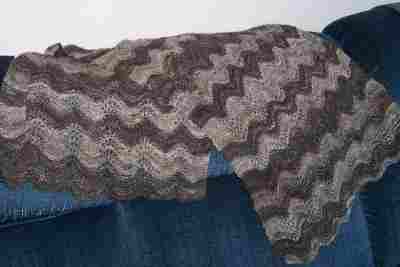 These aren't new creations, but I'm trying to gather up my pictures into a single file folder and thought you might like to see them again. The grey is Beastly Waves. Two different bumps of Beast had very different colors in them, which worked nicely in feather and fan.
 This was the first version of the Katy Shawl. One ply brown Corriedale, one ply blue/purple/green silk. The camera picks up the silk more than is really visible in person - the effect is more subtle. It's a half-pi shawl with snail shell edging. Someday I'll finish oroofing the pattern and post it, unless someone wants to proof it for me.
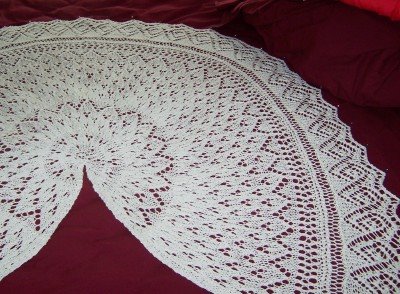 This is the Katy Shawl Mark 2, done in a commercial cotton/silk/polyamide, somewhat bulkier than the original, with slight modifications, like not forgetting to adjust for taking the border stitches out of the body stitch count, which was something I intended to do it in the first version but didn't. It didn't bother me because the first version was a mindless knitting project for meetings, done in a well-what-would-look-good-next sort of fashion.
 Stripes was done in spindle spun BFL, dyed by one of the members of the local guild. The pattern was a variation of the Rebozo from Folk Shawls.
Thursday, July 27, 2006
Summer Reading
It's hot. And Humid. Every summer I remember why I moved away from the East Coast. I love the green of summer in the east - the gold of summer in CA never really seemed right. I love the winters, even when I'm cursing the snow and ice as I drive. I don't mind the cold. But I hate the humidity of summer.
The book list has been interesting. After a long interlude of old favorites (which don't count for counting purposes), I've gone back to reading some new books. Some of the books get to count (I finished them) and some don't.
Bill Bryson: Notes from a Small Island, Neither Here nor There, and A Walk in the Woods. The first two count, the last doesn't. A tremendously funny writer. I started with A Walk in the Woods and was alternately overtaken with hysteria and horror. The thought of setting out on the Appalachian Trail as ill-prepared as these two men seemed to be was totally appalling. His description of their first few weeks of hiking was absolutely side-wrenchingly funny and their dismay when they realized that all the work they had put in only amounted to 2 inches on the overall map of the AT was something I read and re-read to anyone who would hold still. He intersperses his humor with some serious considerations for the future of the AT and the general environment which I found very thought provoking and will necessitate some further research on my part.
Notes from a Small Island and Neither Here Nor There are completely entwined in my mind. I kept putting one book down and picking up the other because I could only find one of them at a time. Reading these made me understand his approach to the AT. He always goes hiking long distances on the spur of the moment without any particular (discussed) preparation. The first book is travel around Britain and the second is travel around Europe. Both of them alternated side-splitting humor with thoughtful discussion of the environment he found himself in.
Linda Berdoll: Mr Darcy Takes a Wife and Darcy and Elizabeth: Nights and Days at Pemberley. (I've gotten into reading Pride and Prejudice fanfic.) This is probably the best of it that I've tried so far. I found the language a trifle strained at times, but the books were good (and bawdy). The first one was better than the second, but there you go. Fun summer reading.
Carrie Bebris: Pride and Prescience. A mystery - reasonably well written. I'll need to try it again another time - I go in and out of reading mysteries and at the moment I'm not even into re-reading mysteries I know and like. I wasn't in the mood to do this one justice.
I'm not much of a fanfic reader as a rule, but I have gotten sucked into this genre just a bit recently on this one subject. It's rather interesting to see the difference between writing a book and establishing the characters and writing a book where you are absorbing already established characters. Of the ones I've read so far, Linda Berdoll has done the best job of explaining and expanding on the established characters.
Allegra Goodman: Intuition a novel. This is a well-written, seemingly well-researched novel about the world of medical research at a university. I thought it a good book but it makes me thankful that I don't have to live in that environment. I'd never make it.
Diane Duane: Stealing the Elf-King's Roses. I hate the cover of the book. I remember when the book came out and I didn't buy it then because of the cover. Unfortunate. It really is a good book. I bought it this time sight unseen, which was my good fortune. Fantasy, set in an alternate universe, complex and well thought out as most of her books are. A good read.
Naomi Novik: His Majesty's Dragon, Throne of Jade and Black Powder War. Three most excellent books. Very readable. Set in Napoleonic times, she seems to have a very good grasp of history and character development, and a very good ability to add a completely new element (dragons) into the set history. I borrowed the first one from the library, on recommendation from an email list. I couldn't wait for them to fetch the next two on library loan; I went and bought them. I'll be waiting for the next one in this series - I want to see where she takes it.
It's hot. And Humid. Every summer I remember why I moved away from the East Coast. I love the green of summer in the east - the gold of summer in CA never really seemed right. I love the winters, even when I'm cursing the snow and ice as I drive. I don't mind the cold. But I hate the humidity of summer.
The book list has been interesting. After a long interlude of old favorites (which don't count for counting purposes), I've gone back to reading some new books. Some of the books get to count (I finished them) and some don't.
Bill Bryson: Notes from a Small Island, Neither Here nor There, and A Walk in the Woods. The first two count, the last doesn't. A tremendously funny writer. I started with A Walk in the Woods and was alternately overtaken with hysteria and horror. The thought of setting out on the Appalachian Trail as ill-prepared as these two men seemed to be was totally appalling. His description of their first few weeks of hiking was absolutely side-wrenchingly funny and their dismay when they realized that all the work they had put in only amounted to 2 inches on the overall map of the AT was something I read and re-read to anyone who would hold still. He intersperses his humor with some serious considerations for the future of the AT and the general environment which I found very thought provoking and will necessitate some further research on my part.
Notes from a Small Island and Neither Here Nor There are completely entwined in my mind. I kept putting one book down and picking up the other because I could only find one of them at a time. Reading these made me understand his approach to the AT. He always goes hiking long distances on the spur of the moment without any particular (discussed) preparation. The first book is travel around Britain and the second is travel around Europe. Both of them alternated side-splitting humor with thoughtful discussion of the environment he found himself in.
Linda Berdoll: Mr Darcy Takes a Wife and Darcy and Elizabeth: Nights and Days at Pemberley. (I've gotten into reading Pride and Prejudice fanfic.) This is probably the best of it that I've tried so far. I found the language a trifle strained at times, but the books were good (and bawdy). The first one was better than the second, but there you go. Fun summer reading.
Carrie Bebris: Pride and Prescience. A mystery - reasonably well written. I'll need to try it again another time - I go in and out of reading mysteries and at the moment I'm not even into re-reading mysteries I know and like. I wasn't in the mood to do this one justice.
I'm not much of a fanfic reader as a rule, but I have gotten sucked into this genre just a bit recently on this one subject. It's rather interesting to see the difference between writing a book and establishing the characters and writing a book where you are absorbing already established characters. Of the ones I've read so far, Linda Berdoll has done the best job of explaining and expanding on the established characters.
Allegra Goodman: Intuition a novel. This is a well-written, seemingly well-researched novel about the world of medical research at a university. I thought it a good book but it makes me thankful that I don't have to live in that environment. I'd never make it.
Diane Duane: Stealing the Elf-King's Roses. I hate the cover of the book. I remember when the book came out and I didn't buy it then because of the cover. Unfortunate. It really is a good book. I bought it this time sight unseen, which was my good fortune. Fantasy, set in an alternate universe, complex and well thought out as most of her books are. A good read.
Naomi Novik: His Majesty's Dragon, Throne of Jade and Black Powder War. Three most excellent books. Very readable. Set in Napoleonic times, she seems to have a very good grasp of history and character development, and a very good ability to add a completely new element (dragons) into the set history. I borrowed the first one from the library, on recommendation from an email list. I couldn't wait for them to fetch the next two on library loan; I went and bought them. I'll be waiting for the next one in this series - I want to see where she takes it.
Tuesday, July 18, 2006
It figures. The first day in days that I've been moved to post and there's a scheduled outage. We'll see if this goes through - I'm not posting pictures (big surprise there) so it may.
Spinning Guild
I've not gotten to guild in months; counter scheduling by the tweens has been rough on my outings. I forget when I don't go just exactly how energized I come home from this monthly outings. I wasn't even particularly interested in this month's topic - I have done KA and EE dyeing and I probably will do KA and EE dyeing again but I'm not interested right now. There weren't that many people there, probably only 20 or so, which given that the guild has over 100, usually averages 30-40 at a meeting and has 60-70 on really special occasions, made this a small meeting. It was hot (no AC) and humid (my silk didn't spin after the first 5 minutes) and my conversations didn't particularly sparkle (gee it's hot, my silk isn't spinning well, is yours?) K was bored silly aside from mastering the basic crochet stitch.
And yet, for all the seeming inanity of any particular meeting, there is a power in getting together in guild with other people who share a passion. I always come home from guild ready to spin, ready to look through my stash, ready to remember what inspired me about any given purchase and what my plans are for it. There is an inspiration to be found in simply being in a room with people to whom I don't need to explain myself. They 'get' why I spin, why I play with fiber, why I knit or crochet, no explanations needed.
I do enjoy spinning in public, teaching people one at a time, about fiber, about spindles, about how it used to be. My children are vaguely proud, vaguely embarassed by me (they are a tween and a teen*, after all); my constant spinning or knitting or crocheting wherever I am, the attention it inevitably draws. I don't do it to draw attention, I do it because (as mentioned previously) it gives me patience and gives me the ability to pay attention.
The guild here is large, as guild go, over 100 spinners who have plunked down their $12 to belong to this guild, with a separate weaver's guild (many of whom are spinners as well) and yet another fiber arts guild with weavers and spinners. There is some cross-membership between the guilds, but only some, and there must be still other spinners unaffiliated with any guild. So, perhaps 350 or 400 people in the Greater Metropolitan Area spin? Out of 1.03 million people - that's .039 percent. My chances of running into another spinner on any given day are pretty slim.
So, I find it energizing to go to guild. The chance to discuss nuances of spinning, rather than repeating, once again, yes, it's a spindle, people used to use them all the time, no, the sheep wasn't red, I dyed it before I started spinning. The internet has been my gateway to spinning, my lifeline that led me into a new and wonderful place, but the guild has been the battery pack that gives it new oomph.
Spinning Guild
I've not gotten to guild in months; counter scheduling by the tweens has been rough on my outings. I forget when I don't go just exactly how energized I come home from this monthly outings. I wasn't even particularly interested in this month's topic - I have done KA and EE dyeing and I probably will do KA and EE dyeing again but I'm not interested right now. There weren't that many people there, probably only 20 or so, which given that the guild has over 100, usually averages 30-40 at a meeting and has 60-70 on really special occasions, made this a small meeting. It was hot (no AC) and humid (my silk didn't spin after the first 5 minutes) and my conversations didn't particularly sparkle (gee it's hot, my silk isn't spinning well, is yours?) K was bored silly aside from mastering the basic crochet stitch.
And yet, for all the seeming inanity of any particular meeting, there is a power in getting together in guild with other people who share a passion. I always come home from guild ready to spin, ready to look through my stash, ready to remember what inspired me about any given purchase and what my plans are for it. There is an inspiration to be found in simply being in a room with people to whom I don't need to explain myself. They 'get' why I spin, why I play with fiber, why I knit or crochet, no explanations needed.
I do enjoy spinning in public, teaching people one at a time, about fiber, about spindles, about how it used to be. My children are vaguely proud, vaguely embarassed by me (they are a tween and a teen*, after all); my constant spinning or knitting or crocheting wherever I am, the attention it inevitably draws. I don't do it to draw attention, I do it because (as mentioned previously) it gives me patience and gives me the ability to pay attention.
The guild here is large, as guild go, over 100 spinners who have plunked down their $12 to belong to this guild, with a separate weaver's guild (many of whom are spinners as well) and yet another fiber arts guild with weavers and spinners. There is some cross-membership between the guilds, but only some, and there must be still other spinners unaffiliated with any guild. So, perhaps 350 or 400 people in the Greater Metropolitan Area spin? Out of 1.03 million people - that's .039 percent. My chances of running into another spinner on any given day are pretty slim.
So, I find it energizing to go to guild. The chance to discuss nuances of spinning, rather than repeating, once again, yes, it's a spindle, people used to use them all the time, no, the sheep wasn't red, I dyed it before I started spinning. The internet has been my gateway to spinning, my lifeline that led me into a new and wonderful place, but the guild has been the battery pack that gives it new oomph.
Tuesday, July 11, 2006
Showers!
Raining, pouring and perfectly quiet - It's raining outside, not inside, ever since the new shower part arrived.
Actually, to be perfectly precise, the new shower parts. Should I think it significant that the new shower part is a slightly different shape, contains different connectors at the four corners, and is accompanied by a few other small parts never seen before in this house?
Can you say "redesign"?
I was sure you could.
Raining, pouring and perfectly quiet - It's raining outside, not inside, ever since the new shower part arrived.
Actually, to be perfectly precise, the new shower parts. Should I think it significant that the new shower part is a slightly different shape, contains different connectors at the four corners, and is accompanied by a few other small parts never seen before in this house?
Can you say "redesign"?
I was sure you could.
Sunday, July 02, 2006
Murphy's Law
If anything can go wrong, it will.
MacGillicudy's Corollary
At the worst possible time.
Some part of the shower handle valve in the master bath is not working. So far, we've replaced the valve and the o-rings. Logic would say, there's only one other part that could be the problem: the pressure regulator. The resident plumber left on Saturday for the week - the corollary would seem to say this would be the perfect time for the problem to completely go haywire. Fortunately, the corollary failed just enough to allow the shower to fail just before he left. He had enough time to muddle around with it, leave me instructions about who to call and what to tell them, and to set it up so that instead of having to turn off all water to the house, we only have to turn off the hot water.
On the other hand, this is a holiday weekend. Instead of being able to call for a part to be sent on Saturday to be received on Monday and installed by me (following the resident plumber's demo of the fix), I get to wait until Wednesday. On Wednesday, the manufacturer's hot line will be open again for taking calls. I called every local supplier and each of them regretfully stated that a. they don't stock that part and b. if the manufacturer isn't taking my calls, they aren't taking the suppliers' calls either. The best they can offer is to come turn off my water for me. Well thanks ever so, we have managed that part. Thank goodness for the membership in the Y for the summer - at least I won't be taking cold showers for a week.
If anything can go wrong, it will.
MacGillicudy's Corollary
At the worst possible time.
Some part of the shower handle valve in the master bath is not working. So far, we've replaced the valve and the o-rings. Logic would say, there's only one other part that could be the problem: the pressure regulator. The resident plumber left on Saturday for the week - the corollary would seem to say this would be the perfect time for the problem to completely go haywire. Fortunately, the corollary failed just enough to allow the shower to fail just before he left. He had enough time to muddle around with it, leave me instructions about who to call and what to tell them, and to set it up so that instead of having to turn off all water to the house, we only have to turn off the hot water.
On the other hand, this is a holiday weekend. Instead of being able to call for a part to be sent on Saturday to be received on Monday and installed by me (following the resident plumber's demo of the fix), I get to wait until Wednesday. On Wednesday, the manufacturer's hot line will be open again for taking calls. I called every local supplier and each of them regretfully stated that a. they don't stock that part and b. if the manufacturer isn't taking my calls, they aren't taking the suppliers' calls either. The best they can offer is to come turn off my water for me. Well thanks ever so, we have managed that part. Thank goodness for the membership in the Y for the summer - at least I won't be taking cold showers for a week.
Monday, June 26, 2006
Sunday, June 25, 2006
The Kodak falcon eyases have fledged and probably won't return to their nestbox. A group of people go down every day and fledgewatch from the bridge, keeping an eye on the fledgelings as they learn to fly and then to hunt. One of people blogs at:
http://marchlords.com/birdblog
http://marchlords.com/birdblog
Saturday, June 24, 2006
Summer's here.
The strawberries are ripe and it's time for Strawberry Bavarian Cream Pie. This can be made with any berry; strawberries or raspberries are recommended. I honestly can't tell you how it tastes with raspberries. It's rich enough I only make it once a year and strawberries are ripe before raspberries, so...
1 quart strawberries, whole -- hulled
1 cup sugar
2 teaspoons gelatin powder, unsweetened (1 packet Knox gelatin is 2 tsp)
3 tablespoons water
3 tablespoons water -- boiling
1 tablespoon lemon juice -- optional
2 cups whipped cream
1 pie crust -- 10 inch pie pan
Mix up pie crust (I like to use 1-1/2 c flour, 1/3 c nut flour, 1/2 tsp salt, 1/2 tsp cinnamon, 1/2 c shortening). Chill dough.
Crush hulled strawberries. Add sugar. Let stand for 1/2 hour.
Roll out pie dough (10 inch pie pan is best; you'll still have filling left over) and bake pie shell at 400 for 10 -12 minutes. Let cool.
Soak 2 t gelatin powder in 3 T lukewarm water.
Stir in 3 T boiling water until dissolved.
Stir into berries, addiing lemon juice if desired.
Cool gelatin mix. When about to set, fold in lightly 2 c whipped cream.
Pour strawberry cream into pie shell. Chill for 8-12 hours.
The extra can go in small single custard dishes or a single dish for scooping from later. It can be eaten at any time, but might be better for several hours of chilling.
This has, of course, a bazillion calories per serving, most of them fat calories, but I don't recommend trying to rescue it from itself. Just make it only once a year.
The strawberries are ripe and it's time for Strawberry Bavarian Cream Pie. This can be made with any berry; strawberries or raspberries are recommended. I honestly can't tell you how it tastes with raspberries. It's rich enough I only make it once a year and strawberries are ripe before raspberries, so...
1 quart strawberries, whole -- hulled
1 cup sugar
2 teaspoons gelatin powder, unsweetened (1 packet Knox gelatin is 2 tsp)
3 tablespoons water
3 tablespoons water -- boiling
1 tablespoon lemon juice -- optional
2 cups whipped cream
1 pie crust -- 10 inch pie pan
Mix up pie crust (I like to use 1-1/2 c flour, 1/3 c nut flour, 1/2 tsp salt, 1/2 tsp cinnamon, 1/2 c shortening). Chill dough.
Crush hulled strawberries. Add sugar. Let stand for 1/2 hour.
Roll out pie dough (10 inch pie pan is best; you'll still have filling left over) and bake pie shell at 400 for 10 -12 minutes. Let cool.
Soak 2 t gelatin powder in 3 T lukewarm water.
Stir in 3 T boiling water until dissolved.
Stir into berries, addiing lemon juice if desired.
Cool gelatin mix. When about to set, fold in lightly 2 c whipped cream.
Pour strawberry cream into pie shell. Chill for 8-12 hours.
The extra can go in small single custard dishes or a single dish for scooping from later. It can be eaten at any time, but might be better for several hours of chilling.
This has, of course, a bazillion calories per serving, most of them fat calories, but I don't recommend trying to rescue it from itself. Just make it only once a year.
Thursday, June 22, 2006
Why do people who don't spin/knit/ weave/crochet/ sew/whatever think that what spinning/ knitting/ weaving/ crocheting/ sewing/ whatevering takes is patience? Patience is what it takes to watch your child do something slowly and clumsily in 3 minutes when you could do it in 15 seconds flat. Patience is what it takes to wait (and wait and wait) at the doctor's office while they don't call your name. Patience is what it takes to wait at the gym (or the soccer field or the baseball field or the music store) while your kid has practice or a lesson. Patience is what it takes to not scream on a 10 hour driving trip when your kid just asked 'are we there yet' for the 15th time and you still have 8 hours to go.
It might take patience to learn to knit or sew or whatever, but after that knitting or sewing or crochet or spinning is what gives me patience to do all of the above. Not a bad return on investment.
It might take patience to learn to knit or sew or whatever, but after that knitting or sewing or crochet or spinning is what gives me patience to do all of the above. Not a bad return on investment.
Tuesday, June 20, 2006
Razzafratza.... Where's Yosemite Sam when you need some really good cussing?
Somehow, in the heat of knitting and watching the CHAMP car race on Sunday, I managed to screw up a line on my Hyrna. Now, each line has two distinct halves. I screwed up the first half (instead of k1, yo, k2, k2tog, yo I managed to k1, yo, k2, yo, k2tog, yo, k2 and went on from there). How I managed to NOT NOTICE THIS at the time, I have no idea, but apparently when I got to the midpoint, I reset and got the second half right. I discovered this after the return trip when I got to the end, some 600 stitches later.
It should be possible, one would think, to just tink back on that side, reknit those stitches and then refinish the purl row. Yes, it is possible, but my tension was different. I had too little yarn to finish the row and now I have too much. So, I'm slowly working my way back across, evening out the tension in the stitches as I go.
Let me just say, it will work. But it would have been quicker and probably easier to just tink the whole damn thing to start with.
Somehow, in the heat of knitting and watching the CHAMP car race on Sunday, I managed to screw up a line on my Hyrna. Now, each line has two distinct halves. I screwed up the first half (instead of k1, yo, k2, k2tog, yo I managed to k1, yo, k2, yo, k2tog, yo, k2 and went on from there). How I managed to NOT NOTICE THIS at the time, I have no idea, but apparently when I got to the midpoint, I reset and got the second half right. I discovered this after the return trip when I got to the end, some 600 stitches later.
It should be possible, one would think, to just tink back on that side, reknit those stitches and then refinish the purl row. Yes, it is possible, but my tension was different. I had too little yarn to finish the row and now I have too much. So, I'm slowly working my way back across, evening out the tension in the stitches as I go.
Let me just say, it will work. But it would have been quicker and probably easier to just tink the whole damn thing to start with.
Monday, June 19, 2006
Camporee! Whee! It wasn't raining. It was too hot. 225 girls, women and men in a perfectly lovely campground on the side of a hill (everything was either up or down) with too many mosquitoes (scritch, scratch) and a lovely cool breeze all day even when it was too hot. The cots didn't suck, the campfire was wonderful, the girls had a good time. We had a nice time with the activities and the hike we took in the evening was a good one.
Question: If the parents had to sign a special release ahead of time to allow the girls to have facepaint put on, why on earth did they tie dye shirts without gloves or notice to the parents? There were some pretty purple hands going home.
We hibernated on Sunday. The temp was up over 90 and as I may have mentioned once or twice, anything over 75 makes me melt. Today is a more reasonable 80 with rain showers.
Question: If the parents had to sign a special release ahead of time to allow the girls to have facepaint put on, why on earth did they tie dye shirts without gloves or notice to the parents? There were some pretty purple hands going home.
We hibernated on Sunday. The temp was up over 90 and as I may have mentioned once or twice, anything over 75 makes me melt. Today is a more reasonable 80 with rain showers.
Thursday, June 15, 2006
Odds and ends
It's been a peculiar week. We went on Saturday (KIP day - I had my shirt on) to the Aquarium at Niagara Falls. Nice little aquarium. The subject of knitting in public came up and one of the other mothers said "Well, it's nothing new for her. She's ALWAYS knitting. She even knitted through Intermurals." (Well - Duh! Sitting through 1.5 hours of supervising 3 boys bowling, or 1.5 hours of watching other people supervising 12 kids playing tennis?) Another woman came out with that standard "I just couldn't knit. I don't have the patience" and I gave her my standard " I don't have the patience not to knit". She gave me sort of a double take...
I need to update my list of books read - One Good Knight by Mercedes Lackey was quite amusing. I'm stuck in Philip Pullman's The Golden Compass - don't know if I'll finish it. I'm in the middle of A Walk in the Woods and Notes from a Small Island and Neither Here nor There, all by Bill Bryson. My MIL lent me all three and I keep being able to find only one at a time, not the one I was most recently reading. All have hysterically funny moments in them, as well as, WHAT on EARTH were you THINKING? moments.
I found a copy of Ha!Ha! 24 Great Comedy Songs on the discount rack at the grocery store. I've never heard Anything You Can Do all the way through before, or anything but the title of I'm My Own Grandpa. It's got Flat Foot Floogie, which is one of those serendipitous moments as I was just watching a Looney Tunes cartoon which referred to this song and the commentary mentioned which song was being referred to. (The more period music I know, the funnier the Looney Tunes cartoons are because many of the musical motifs used were from contemporary music that emphasizes the action on the screen. And yes, I'm a Looney Tunes junky.)
I've been trying to get caught up on my sleep since the weekend (overnight at the aquarium with 15 Cub Scouts) and moving books on Tuesday morning followed by moving dirt on Tuesday afternoon left me with muscle twitches that interrupted sleep Tuesday night. I staggered around like a zombie Wednesday. I did manage a nap Wednesday afternoon but that merely changed the quality of my zombieness as I moved into that state where one's head is stuffed with cotton wool and nothing really processes. A reasonable night's sleep last night left me with merely a headache this morning and a desire to avoid doing anything useful. Maybe a swim will help.
It's been a peculiar week. We went on Saturday (KIP day - I had my shirt on) to the Aquarium at Niagara Falls. Nice little aquarium. The subject of knitting in public came up and one of the other mothers said "Well, it's nothing new for her. She's ALWAYS knitting. She even knitted through Intermurals." (Well - Duh! Sitting through 1.5 hours of supervising 3 boys bowling, or 1.5 hours of watching other people supervising 12 kids playing tennis?) Another woman came out with that standard "I just couldn't knit. I don't have the patience" and I gave her my standard " I don't have the patience not to knit". She gave me sort of a double take...
I need to update my list of books read - One Good Knight by Mercedes Lackey was quite amusing. I'm stuck in Philip Pullman's The Golden Compass - don't know if I'll finish it. I'm in the middle of A Walk in the Woods and Notes from a Small Island and Neither Here nor There, all by Bill Bryson. My MIL lent me all three and I keep being able to find only one at a time, not the one I was most recently reading. All have hysterically funny moments in them, as well as, WHAT on EARTH were you THINKING? moments.
I found a copy of Ha!Ha! 24 Great Comedy Songs on the discount rack at the grocery store. I've never heard Anything You Can Do all the way through before, or anything but the title of I'm My Own Grandpa. It's got Flat Foot Floogie, which is one of those serendipitous moments as I was just watching a Looney Tunes cartoon which referred to this song and the commentary mentioned which song was being referred to. (The more period music I know, the funnier the Looney Tunes cartoons are because many of the musical motifs used were from contemporary music that emphasizes the action on the screen. And yes, I'm a Looney Tunes junky.)
I've been trying to get caught up on my sleep since the weekend (overnight at the aquarium with 15 Cub Scouts) and moving books on Tuesday morning followed by moving dirt on Tuesday afternoon left me with muscle twitches that interrupted sleep Tuesday night. I staggered around like a zombie Wednesday. I did manage a nap Wednesday afternoon but that merely changed the quality of my zombieness as I moved into that state where one's head is stuffed with cotton wool and nothing really processes. A reasonable night's sleep last night left me with merely a headache this morning and a desire to avoid doing anything useful. Maybe a swim will help.
Monday, June 05, 2006
There is that old saying: "When the student is ready, the teacher will appear." When I was younger, I thought of this saying as a sort of metaphysical "The universe will move a teacher to your location as soon as you are really ready." I have come to believe somewhat the opposite as I have grown older: I believe that teachers are all around us, giving us information all the time. When the student is ready, they hear the information they need. Until the student is ready, the information doesn't stick.
It's a variant on that other phenomenon that once you hear about one xyz, you suddenly hear about xyz in all sorts of contexts. It really just means that you have become sensitized to xyz.
The relevance? Well, a short while back, June of Twosheep posted a lovely entry on the subject of keeping one's grist constant through the simple use of an index card. Place several wraps of a singles around an index card and fasten them down under tension. Then, as you are spinning, every so often lay a current bit of singles between the ones on the card and see/feel how it looks.
June credits Elaine Benfatto with telling her about it, and it is very possible that I was on a list to which Elaine posted this idea before; it sounds vaguely familiar. But when I (may have) heard this before, I wasn't ready for the information. It didn't stick. Now, it's a solution to a problem I know I have but hadn't addressed consciously. When I read June's discussion of the technique, I went Aha! Just what I need.
I used to spin one thing at a time. I had one wheel, I had no particular use for spindles (I had only two spindles, both the same size) (whoops sorry, I had a boat anchor too; I still have no use for that one). I spun one fiber til I was done and then moved on. Sometimes I stopped for a while and had trouble getting back to the grist I had been spinning, but all in all it worked fairly well.
Now I have multiple spindles at varying weights and I have (shhh!) several different projects going on the wheel. Keeping track of making even grist has become more important to me. This is the (current) perfect solution to my problem. And the proof of the pudding is that my grist on the latest two skeins of the same thing is 1. 1490 ypp and 2. 1450 ypp, which is really good for me and well within the tolerance level of my ability to measure either weight or length; i.e. my ability to do either with my current measuring tools has a fair amount of error built in. Best of all, the skeins feel like they go together, which has not always been the case on previous projects.
It's a variant on that other phenomenon that once you hear about one xyz, you suddenly hear about xyz in all sorts of contexts. It really just means that you have become sensitized to xyz.
The relevance? Well, a short while back, June of Twosheep posted a lovely entry on the subject of keeping one's grist constant through the simple use of an index card. Place several wraps of a singles around an index card and fasten them down under tension. Then, as you are spinning, every so often lay a current bit of singles between the ones on the card and see/feel how it looks.
June credits Elaine Benfatto with telling her about it, and it is very possible that I was on a list to which Elaine posted this idea before; it sounds vaguely familiar. But when I (may have) heard this before, I wasn't ready for the information. It didn't stick. Now, it's a solution to a problem I know I have but hadn't addressed consciously. When I read June's discussion of the technique, I went Aha! Just what I need.
I used to spin one thing at a time. I had one wheel, I had no particular use for spindles (I had only two spindles, both the same size) (whoops sorry, I had a boat anchor too; I still have no use for that one). I spun one fiber til I was done and then moved on. Sometimes I stopped for a while and had trouble getting back to the grist I had been spinning, but all in all it worked fairly well.
Now I have multiple spindles at varying weights and I have (shhh!) several different projects going on the wheel. Keeping track of making even grist has become more important to me. This is the (current) perfect solution to my problem. And the proof of the pudding is that my grist on the latest two skeins of the same thing is 1. 1490 ypp and 2. 1450 ypp, which is really good for me and well within the tolerance level of my ability to measure either weight or length; i.e. my ability to do either with my current measuring tools has a fair amount of error built in. Best of all, the skeins feel like they go together, which has not always been the case on previous projects.
Subscribe to:
Posts (Atom)